
Back to Main Page

AI driven
Mobile app
Game Interaction Design
Industry:
Media Tech
Company:
**confidential**
Year:
2025
Role:
Senior Product Designer
Market:
🇮🇪 Ireland
"Building for children is building for trust — the child's trust in delight, and the parent's trust in purpose."
Building products for children is uniquely challenging. Children need experiences that feel playful, intuitive, and rewarding — while parents need confidence that their children are learning, growing, and using technology meaningfully.
A leading children's entertainment company set out to expand beyond media by creating an AI-powered educational platform that combined storytelling, interactive games, and curriculum-based learning. The vision was ambitious: transform passive content consumption into active learning while giving parents meaningful visibility into their child's development.
I joined the project in its early stages, helping define the product strategy, shape the MVP, and establish the design foundations that would support future growth. The result was a scalable learning ecosystem that connected entertainment, gameplay, and AI-driven insights into a cohesive experience for both children and parents.
Overview
The Context
The company had an established presence in children's entertainment and saw an opportunity to expand into educational technology through an entirely new business model. Rather than extending an existing show or character universe, they envisioned a scalable platform capable of hosting multiple educational TV shows — each with its own interactive games, learning journeys, and progression systems.
At the time, the characters and narrative for the first show were still being developed by a separate content production team. This added an extra layer of complexity: we had to design a flexible product ecosystem that could support evolving content, unknown future franchises, and entirely different worlds from day one. Instead of building around a single intellectual property, we were creating the foundation for an expandable educational entertainment platform.
My Role
Senior Product Designer
I partnered closely with product, engineering, and stakeholders to define the product experience from the ground up.
Leading product discovery and research
Defining the MVP experience and product architecture
Designing both the children's and parent experiences
Creating interaction prototypes for core learning flows
Establishing the initial design system foundations
Collaborating with developers on complex game interactions
The Challenge
This was far more than designing a kids app
Rather than building a traditional educational app, the goal was to create an ecosystem where children could learn through play while parents gained clear, actionable insights into their development. AI would play a central role, translating gameplay into meaningful learning data.
Children's Experience
Needed an experience that felt fun, intuitive, rewarding, and genuinely educational — with minimal reading requirements.
Parent Trust & Visibility
Parents needed visibility, trust, control, and meaningful insights — not dashboards full of raw data.
Business Scalability
The platform had to support multiple games, learning journeys, and AI-driven insights across future content franchises.
Design from Scratch
We had to design for multiple cognitive development stages and build scalable foundations from day one.
On top of that, we had to design for multiple cognitive development stages, build the product from scratch, and establish scalable foundations from day one.
Process
Discovery
Research & Discovery
During the discovery phase, we focused on understanding how children learn through digital experiences and how parents interact with educational platforms.
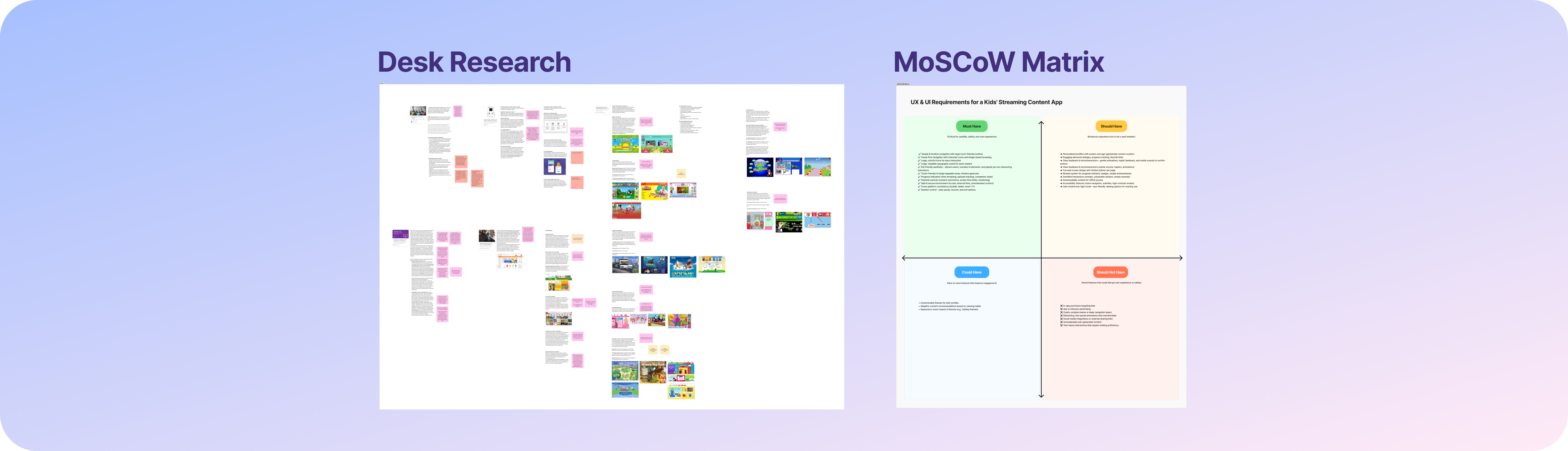
Desk research explored children's learning patterns in digital environments, best practices in educational game design, parental expectations around learning apps, and existing edtech platforms. We also investigated child cognitive development stages, gamification patterns, parental control models, and educational frameworks used in school curriculum. These insights directly shaped the product's core interaction model and information architecture.
Strategy
Defining the Strategy
The central question became: How might we create a learning experience children genuinely enjoy while giving parents confidence that meaningful learning is happening?
We aligned around three strategic pillars:
Story-driven learning
Characters and storylines became the narrative foundation for the learning journeys.
Game-based education
Children learn through short interactive games designed to practice skills aligned with school curriculum.
Parent insights
Transforming learning signals into understandable progress — not raw data.
Execution
Designing Two Products in One
The biggest challenge was that this wasn't a single-user product — it was two deeply interconnected experiences.
Children needed an interaction-first environment built around exploration, experimentation, and short game loops. Reading requirements had to be minimal, and every interaction needed to feel immediately understandable. Parents, on the other hand, needed clarity, control, and actionable insights — their experience focused on progress tracking, screen-time management, and developmental guidance.
Turning AI into Something Parents Can Trust
AI wasn't the product. Trust was.
As children completed activities, the platform captured performance signals across different learning dimensions. These signals were processed by AI models that identified strengths and developmental opportunities. Our role was translating that complexity into simple, human-centered insights parents could immediately understand and act upon. Parents didn't want more data — they wanted clarity.

Deep Dive: Designing a Music-Based Learning Game
One of the most interesting challenges was creating a rhythm-based piano game inspired by games like Guitar Hero. The goal was to help children practice timing, coordination, and pattern recognition through musical play. As notes descended the screen, children needed to tap the corresponding piano keys at exactly the right moment — difficulty scaled progressively, maintaining engagement without overwhelming younger users.
Designing this experience required close collaboration with engineering to balance interaction responsiveness, visual clarity, and technical feasibility. It became a great example of where product design, game design, and engineering intersect.
Early-stage prototype recorded during internal testing. At this point, sound effects, success and error messages, and scoring had not yet been implemented.
Validation
Research Principles That Shaped the Product
Key insights from discovery directly informed every major design decision across the ecosystem.
01
How do children build habits through digital play?
02
What makes a parent trust an educational product?
03
How might AI insights be explained without overwhelming?
Outcomes
What We Established
2
Distinct user experiences designed
0→1
Product built from the ground up
∞
Content franchises the platform can support
1
Unified design system for both interfaces
Children's Engagement
Short, game-based learning loops proved highly effective at driving repeat engagement. Playfulness drove children deeper into learning journeys.
Parent Confidence
Simplified AI-powered progress reporting — instead of raw data — gave parents the clarity and trust they needed to remain engaged with the platform.
Key Takeaways
Although the product was still in its early stages, this project reinforced several principles that continue to shape my approach to product design.
"The best time to invest in foundations is before complexity arrives."
Playfulness drives engagement
Children engage more deeply when learning feels like play — not instruction.
Simplicity is a feature
Especially when designing for young users, every unnecessary cognitive step creates friction.
Insights matter more than raw data
Parents need clear, actionable guidance — not overwhelming dashboards filled with metrics.
Scalable systems matter early
The best time to invest in foundations is before complexity arrives.
By the end of the engagement, we had aligned stakeholders around a shared product vision, accelerated future development through reusable design foundations, and created an ecosystem ready to support expansion across new shows, games, and learning journeys.
More Projects

EdTech
Rebuilding an AI product to reduce time to value by 50x
Redesigning the user journey to accelerate activation, improve conversion, and unlock growth

Chat-commerce
Design System Restructuring
Creating a single source of truth for scalable product design

Healthcare / HealthTech
Healthcare Marketplace Platform
Simplifying a multi-actor healthcare ecosystem