
Back to Main Page

AI
SaaS
B2C
Product Redesign
Multi-device
Industry:
EdTech
Company:
CoGrader
Year:
2024
Role:
Founding Product Designer
Market:
🇺🇸 United States
"Teachers don't adopt grading tools because they're impressed by AI. They adopt them because they save time."
At CoGrader, we had a growing base of highly engaged advocate teachers, but expanding beyond that audience was not that easy. AI in education was still new territory, and most teachers simply didn't have the time — or patience — to experiment with multiple tools.
Many had already tried tools like ChatGPT or Gemini, often with mixed results, and weren't actively looking for another platform to test.
We needed to make CoGrader's value obvious, immediately. Teachers should experience that "wow, this actually works" moment, faster.
Our engineering team was developing a new multi-agent AI architecture that dramatically improved grading quality, speed, and consistency. It was the perfect opportunity to rethink the entire experience — not just redesign the interface. So instead of iterating on the existing product, we rebuilt it from the ground up.
The result: teachers could experience CoGrader's value nearly 50 times faster, leading to stronger activation, higher conversion, and a more scalable foundation for growth.
Overview
The context
CoGrader helps teachers provide high-quality feedback on student writing using AI. After a full school year, we had accumulated extensive teacher feedback, identified several friction points, and learned where the existing experience was holding us back.
At the same time, our engineering team was developing a new AI grading architecture. With back-to-school season approaching, we saw the perfect opportunity: rebuild the product from the ground up, aligning a new AI engine with a new user experience.
My Role
Founding Product Designer
I partnered closely with engineering, product, and growth to define the new experience, design the critical workflows, validate assumptions with users, and prepare the product for launch.
- →Leading discovery and synthesis
- →Facilitating co-creation workshops
- →Designing the new grading workflow
- →Creating a conversion-focused demo experience
- →Testing the new AI grading experience with teachers
- →Supporting launch readiness across the company
The Challenge
This was far more than a visual refresh
We were redesigning the grading experience around a brand-new AI architecture, under a strict deadline, while minimizing disruption for existing users. Teachers were interested in AI, but skeptical — busy, overwhelmed, and reluctant to invest time testing unfamiliar tools. Every extra step between signup and value created friction.
To succeed, we needed to:
Experience value immediately
Help new users reach their "wow" moment before losing them to complexity or doubt.
Reduce activation friction
Cut every unnecessary step between signup and the first successful grading experience.
Make AI feel trustworthy
Make AI feel useful and reliable, not experimental or risky for busy teachers.
Leverage the new AI engine
Build a grading workflow that fully took advantage of the new multi-agent architecture.
Expand beyond desktop
Redesign the product to match real user behavior across mobile, tablet, and desktop.
And, of course, we had to do all of that before back-to-school season. No pressure.
Process
Discovery
Throughout the school year, we continuously gathered feedback from teachers. A clear pattern emerged: CoGrader was powerful, but it took too long for users to experience that power. Teachers wanted immediate proof that the product could help them. Every extra step before that moment created unnecessary friction. This insight shaped the entire project.
Defining the strategy
The key question became: How might we help more teachers quickly understand CoGrader's value and confidently take the next step? This was as much a business problem as a design one. We focused on three strategic priorities:
Reduce time to first value
Minimize the time between first interaction and first successful grading experience.
Remove device barriers
Eliminate device-related drop-off that was limiting activation at the top of the funnel.
Reimagine the grading workflow
Rebuild the core experience around the capabilities of the new AI engine — not just wrap new tech in the old UI.
Designing the new experience
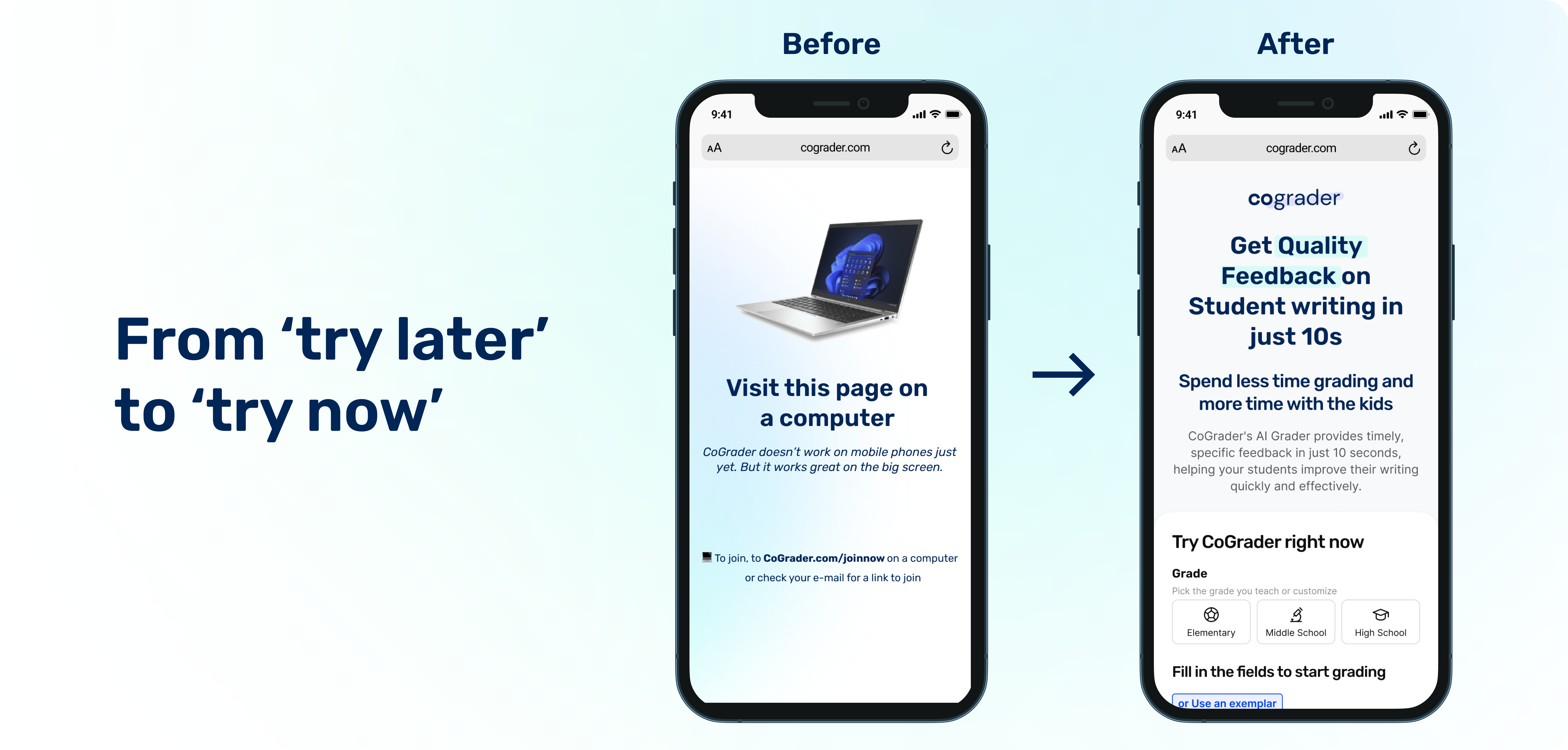
Most teachers first heard about CoGrader through social media — usually on their phones. Many would visit our landing page, sign up, and then hit an immediate roadblock: the product only worked on desktop. They had to switch devices just to try it. Too often, that "later" never happened.
By redesigning CoGrader for desktop, tablet, and mobile, we allowed teachers to explore the product the moment they discovered it — on whichever device they were already using. This significantly reduced drop-off at the top of the funnel.
And interestingly, post-launch behavior validated this decision in a big way.
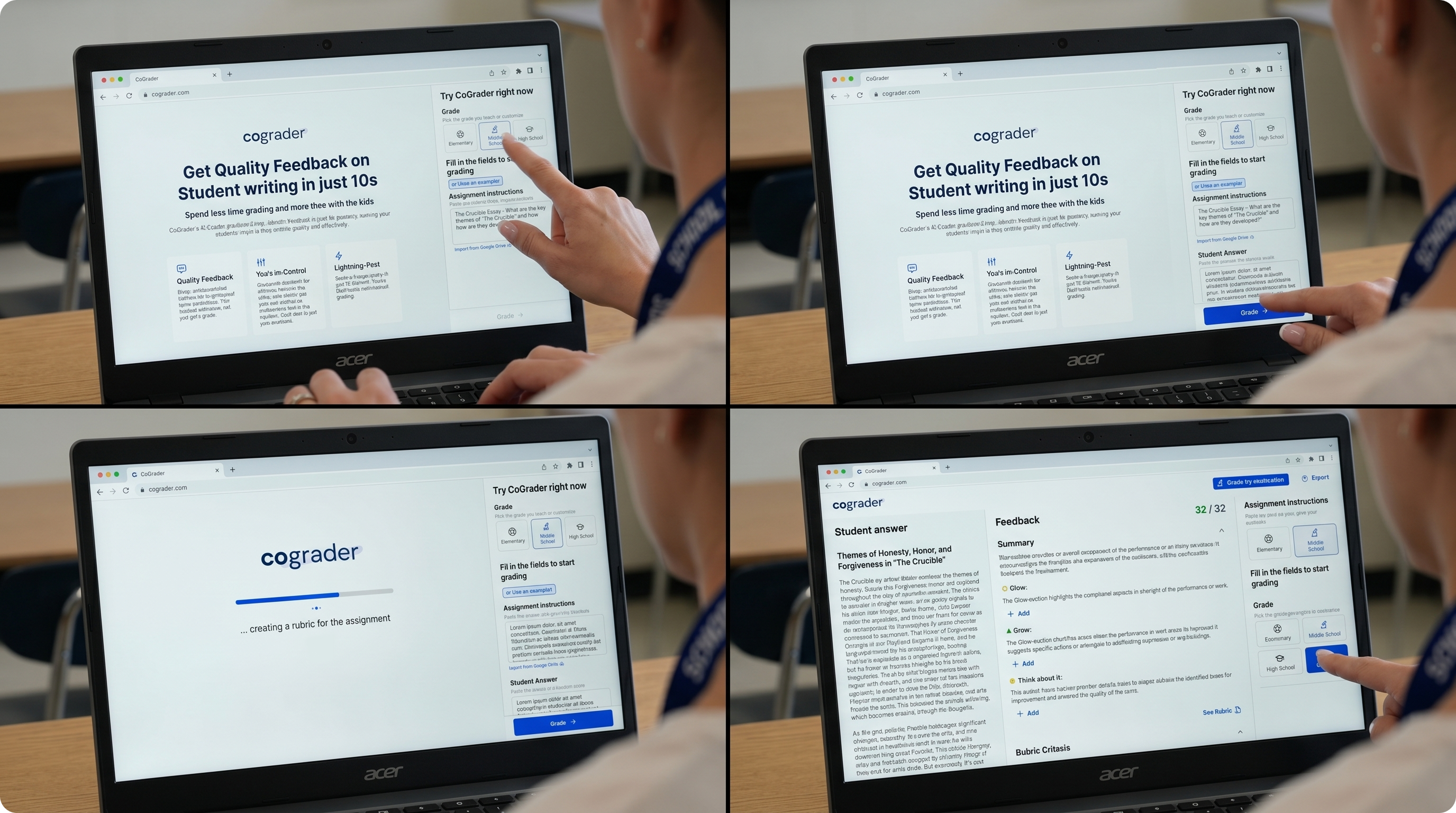
Previously, testing CoGrader required a substantial upfront investment. Teachers had to create an account, upload an assignment, configure rubrics, and only then could they see the product in action. That was a lot to ask from a busy teacher evaluating a new tool.
We introduced an interactive demo that removed those barriers entirely. Prospective users could immediately experience the full grading workflow — either by uploading their own assignment or by using a preloaded sample — with no account required. The demo became one of the most impactful parts of the redesign, dramatically boosting time to value.
Once teachers experienced the product's value, the next challenge was helping them incorporate it into their daily workflow — driving long-term retention.
We redesigned the grading flow around the capabilities of the new AI engine, making the experience faster, more transparent, and easier to trust. Good AI UX isn't about making AI look smart — it's about making users feel confident. This benefited both new and existing users: new teachers could move from trial to adoption with ease, while experienced users gained a significantly more efficient grading workflow built for everyday use.
Drag to compare the old and new grading interface:


Validation
Testing what mattered most
Given our timeline, we focused on validating the highest-risk areas — testing the new interactive demo, the redesigned grading flow, and the new AI agent with teachers from our advocate program.
01
Could users easily navigate the new workflow?
02
How did they feel about the redesigned grading experience?
03
Did the AI-generated feedback feel trustworthy and useful?
Testing the AI and the interface together was essential — the experience depended on both. Their feedback helped us refine both before launch and gave us confidence that existing users would successfully transition.
Results
Meaningful impact across user experience and business
50x
Faster time to value
<30s
Demo completion time
↑↑
Activation and lead conversion
↓
Mobile drop-off rate
We also uncovered an interesting behavioral pattern post-launch:
Mobile users
Used the preloaded sample demo frequently, completing their trial in under 30 seconds — comparable to watching a short social media video.
Desktop users
More likely to upload their own assignments and explore deeper functionality.
These insights demonstrated that the redesign successfully catered to different user needs and contexts, optimizing the experience across devices.
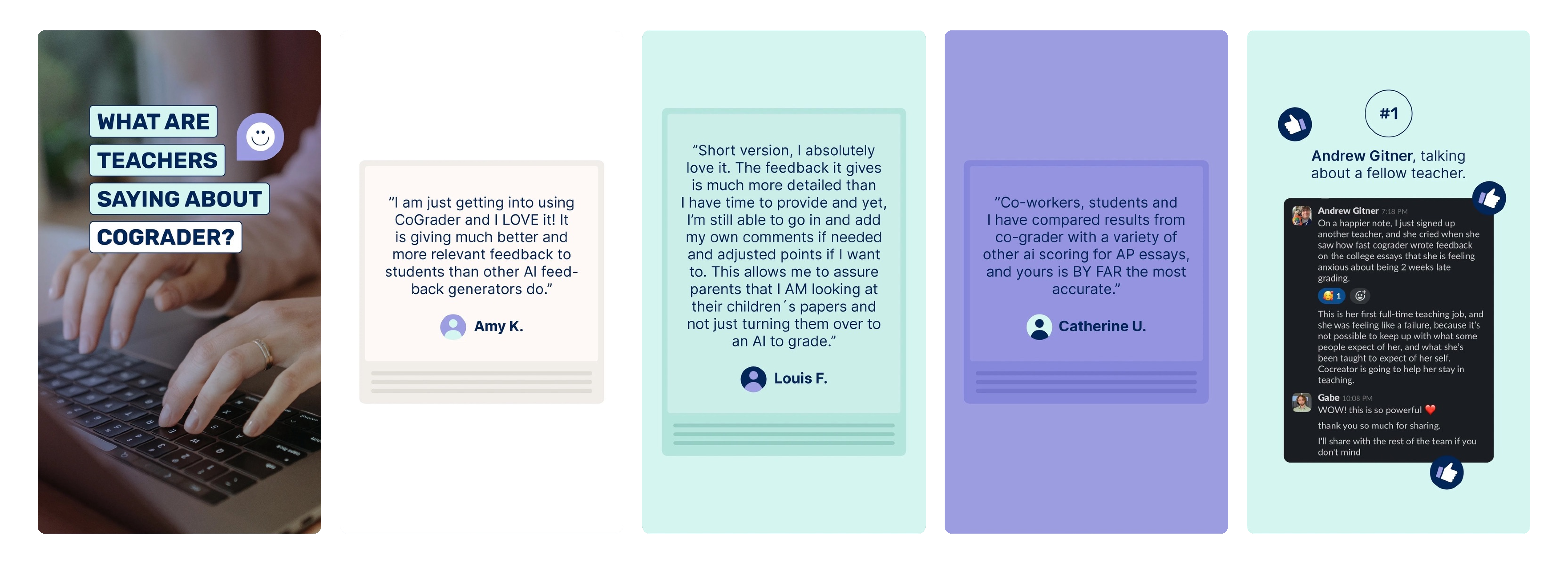
Key Takeaways
This project reinforced something I deeply believe:
"Great product design creates value for users — and growth for the business."
Reducing time to value and redesigning the grading workflow wasn't just a UX improvement. It directly impacted activation, conversion, and CoGrader's ability to scale. This project also reinforced something I've seen throughout my career: the best outcomes happen when product, design, engineering, and business strategy evolve together.
And yes, we shipped before back-to-school season. Always a satisfying milestone.
More Projects

Media Tech
AI-powered Kids Learning App
Balancing playful learning for children with insights and control for parents

Chat-commerce
Design System Restructuring
Creating a single source of truth for scalable product design

Healthcare / HealthTech
Healthcare Marketplace Platform
Simplifying a multi-actor healthcare ecosystem